
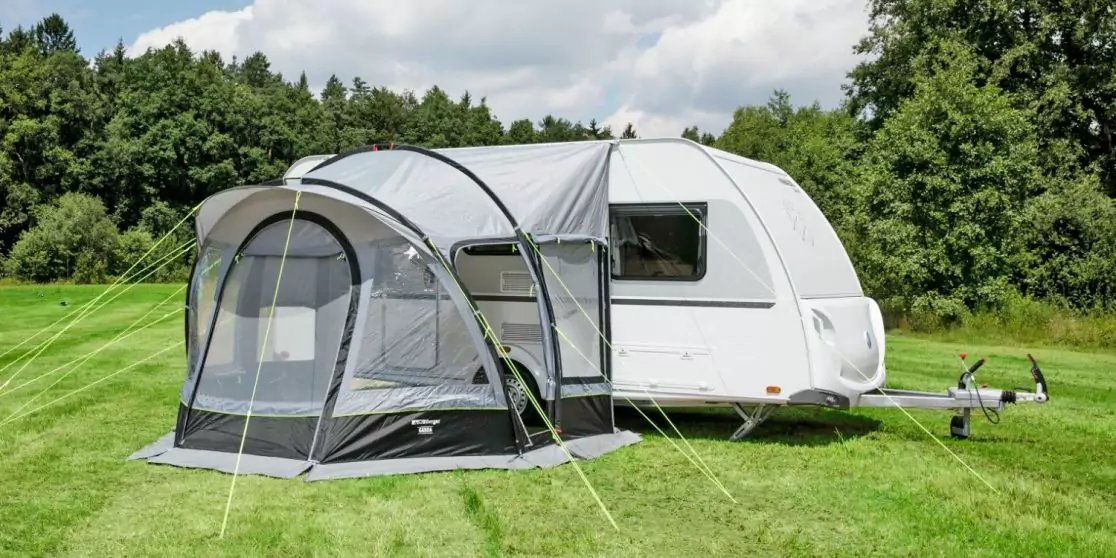


How to Secure Your Awning Against Strong Winds
Correct fastening and support
An awning can only withstand storms if it is properly tensioned and firmly anchored to the ground. With the right storm supports and additional poles, you can make your awning fit for windy regions.
Table of contents
Wind-proof awnings
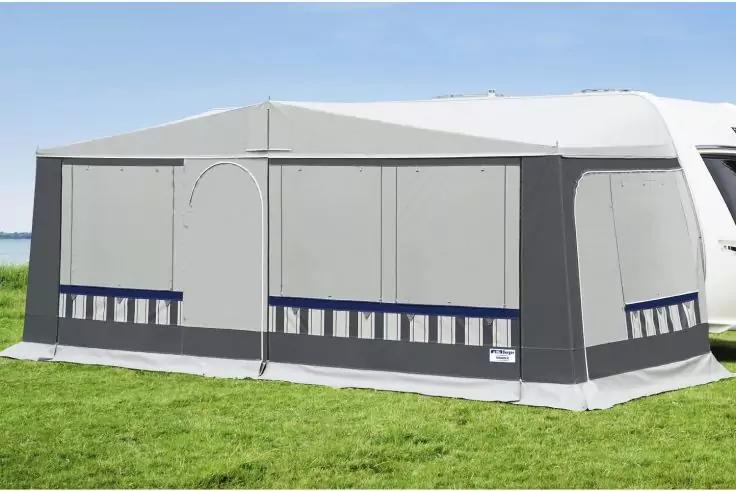
When it comes to stability in wind and weather, there are differences between the individual awning types. Particularly stable are winter awnings. Due to their small surface area, winter awnings offer the wind little surface to attack.
Also well suited in windy regions are all-season awnings. They are made of more durable material than the lightweight summer awnings.
In principle, a wind-stable awning should not be deeper than 2.5 metres. With larger awnings, the side walls provide too much surface for the wind to attack.
Stormproof does not mean that the awning can withstand any hurricane. Particularly severe storms with speeds of over 100 km/h can cause even a caravan to topple over, and the awning will not stand up under such extreme conditions. But don't worry: at the campsite, the caravan is usually sheltered from the wind between other caravans, mobile homes and sanitary facilities. Storm damage during camping is the exception.
Secure correctly
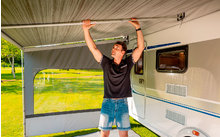
The thickest frames are of no use if the awning is not properly tensioned. When setting up, make sure that all lines are properly tightened. Even though the awning already seems to be stable with part of the guy ropes. Start with the rear guy points and then fix the two guy lines to the front corners of the awning. Only when the corner points are tensioned do you attach the remaining guy lines. Also look at the roof of the awning while securing.
Make sure that the tent tarpaulin is also tightly stretched on the roof. Otherwise, water pockets can form when it rains. You can optionally extend your Berger awning with a roof support pole. This angled additional pole ensures that the roof is tensioned at the optimum angle and that rainwater can run off unhindered.
Here you can find tent pegs & tensioning materials in the Berger online shop.
Strong winds often bring rain as well. Align the awning so that the roof is taut. This is how you avoid water pockets.

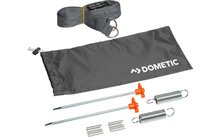
Secure awning with storm strap
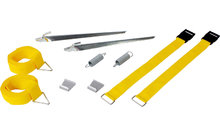
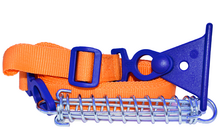
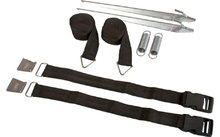
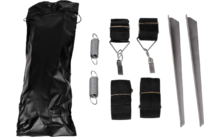
A storm strap, also called a "tie down", is a wide and flat belt. High-quality storm straps are made of weather-resistant plastic fabric. A storm strap has a fixed lock that cannot be released on its own. This makes the storm strap much more resilient than a conventional guy line. There are two ways to attach a storm strap to the awning:
- The storm strap is laid over the tent roof and fixed in the ground to the right and left of the awning with pegs. In this case, you should place a chafe guard between the storm strap and the tent skin. Otherwise, the outer material can be damaged by the resulting friction.
- If there are plastic buckles on the sides of the awning, you can click in one storm strap on the right and one on the left.
Many storm straps have a steel spring between the strap and the peg. The spring relieves the strain on the belt during gusts of wind.
Here you can find storm straps in the Berger online shop.
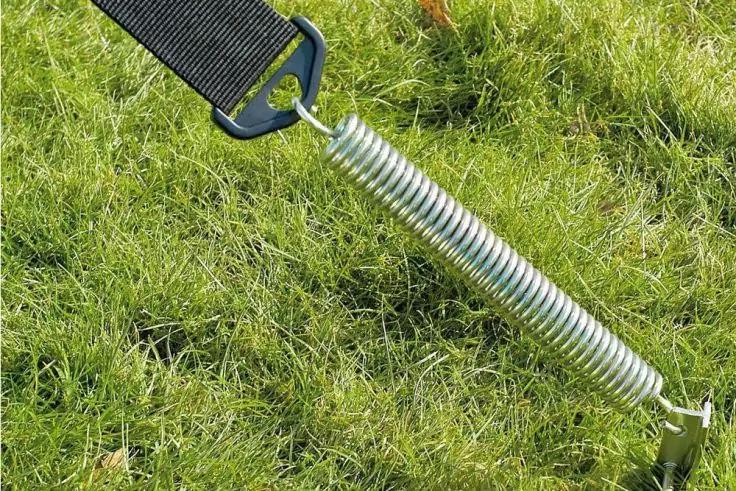
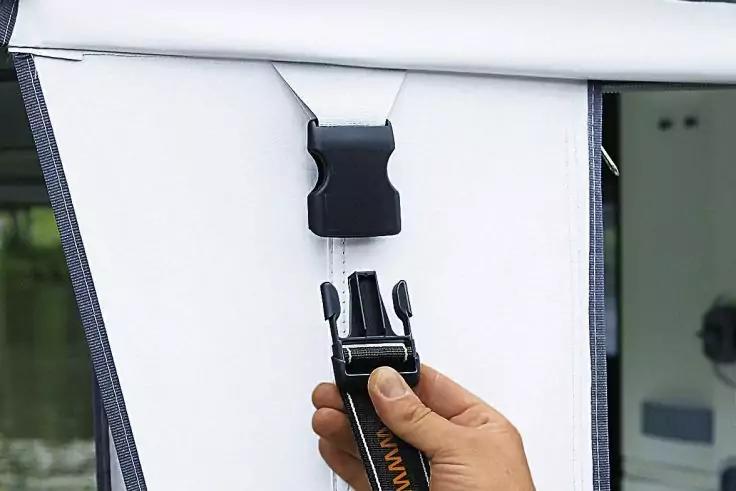
Important: the storm strap should only be loosely tensioned. If it exerts permanent pressure on the awning, it can be damaged.


Robust basic framework and add-on frame
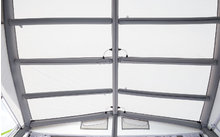
The stability of the frame depends not only on the material, but also on the diameter of the poles. The larger the diameter, the more stable the frame. If you are camping in windy regions, the diameter of the frame should ideally be 32 millimetres.
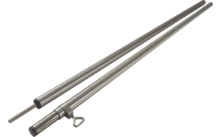
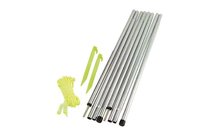
Additional stability is provided by storm poles or storm supports. They complement the basic framework of the awning. Here you can find storm supports in the Berger online shop.
With some awnings, you can buy frame and tent skin separately. For example, the all-season awning Berger Fehmarn IV. When ordering, you can choose between different perimeters to suit your caravan. Independently of the tent skin you can order the basic framework with 28 or 32 millimetres diameter and optionally made of aluminium or steel.
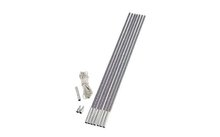

Correct tensioning of awning frames
To ensure that the frame is as stable as possible, the individual elements must not be too loose. With the hand, an enormous amount of force would be needed to generate the required tension. That is why there are so-called pole tensioners, which make it easier to tension the awning poles.
In video: How the Isabella Hercules Triple boom tensioner works
The right tent pegs for the awning
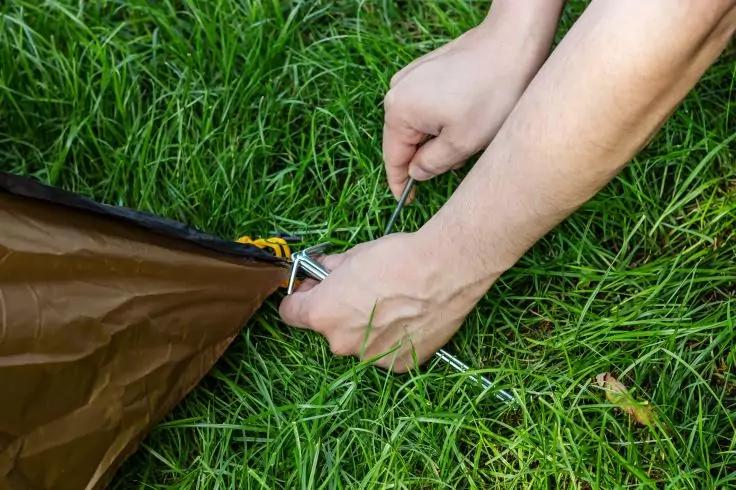
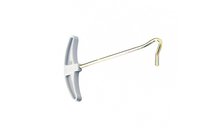
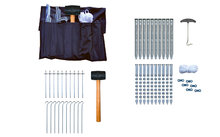
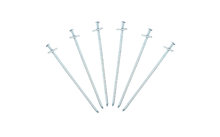
There are different types of tent pegs for different soils. Thin round pegs are easier to hammer into stony ground, while flat and narrow pegs find better hold in sandy ground.
To ensure that your awning is properly anchored in the ground, you should choose the right peg.

Conclusion: Don't spare the effort
Wind and weather cannot harm an awning - if it is sufficiently secured. Clean fastening and the installation of additional poles is worthwhile. Because an awning is not a cheap camping accessory. If it breaks due to missing guy ropes, storm supports or wrong pegs, no insurance will cover the damage.